- Need any help? Call : Call or chat with us: +91 8887594424
- Support : inquiry@inventorigin.com

Recent Post


Ultimate Guide Cloud Modern
15 October 2024
IT Consulting Can Boost
15 October 2024
Services we offer
End-to-End IT Services Built for the Future
We offer a full spectrum of IT services designed to help organizations modernize, scale, and compete in a rapidly evolving digital landscape. Whether you're a startup laying your technology foundation or an enterprise undergoing large-scale digital transformation, our expert teams bring the strategy, engineering, and support you need to succeed.
From cloud infrastructure and cybersecurity to custom software and AI integration — we deliver comprehensive IT solutions that power business growth, resilience, and digital transformation.
200+Projects Delivered
98%Client Satisfaction
20+Years of Expertise
Managed IT Services — Your IT Department, Outsourced
For growing businesses that need enterprise-grade IT without the overhead, our Managed IT Services model gives you a dedicated team of engineers, analysts, and consultants available around the clock — at a predictable monthly cost.
99.9%Uptime SLA Guarantee
24/7/365Monitoring & Support
100%Built-In Security & Compliance
500+Enterprise Clients Served
Cloud Services & Migration
Cloud services and migration enable scalable infrastructure, seamless data transfer, reduced costs, improved performance, and enhanced security, helping businesses modernize applications and accelerate digital transformation efficiently.
AI & Machine Learning
AI & Machine Learning services enable intelligent automation, predictive insights, and data-driven decisions, helping businesses optimize operations, enhance customer experiences, and accelerate innovation across industries.
Cybersecurity Services
Cybersecurity services protect systems, networks, and data through threat detection, risk assessment, encryption, monitoring, and incident response, ensuring secure, compliant, and resilient business operations.
Custom Software Development
Custom software development services deliver tailored, scalable solutions aligned with business needs, enhancing efficiency, integration, user experience, and long-term growth through modern technologies and agile methodologies.
Resource Outsourcing
Resource outsourcing services provide skilled talent, reduce costs, enhance flexibility, and allow businesses to focus on core activities while improving efficiency, scalability, and operational performance.
DevOps & CI/CD
AI-powered cybersecurity enhances productivity by detecting threats in real time, automating responses, reducing downtime, protecting data, and enabling businesses to operate securely and efficiently at scale.
Data Analytics & BI
AI-powered cybersecurity enhances productivity by detecting threats in real time, automating responses, reducing downtime, protecting data, and enabling businesses to operate securely and efficiently at scale.
IT Infrastructure & Managed Service
AI-powered cybersecurity enhances productivity by detecting threats in real time, automating responses, reducing downtime, protecting data, and enabling businesses to operate securely and efficiently at scale.
ERP & CRM Implementation
AI-powered cybersecurity enhances productivity by detecting threats in real time, automating responses, reducing downtime, protecting data, and enabling businesses to operate securely and efficiently at scale.
IT Consulting & Digital Strategy
AI-powered cybersecurity enhances productivity by detecting threats in real time, automating responses, reducing downtime, protecting data, and enabling businesses to operate securely and efficiently at scale.
Our Proven Delivery Process
A structured, transparent engagement model that ensures every project is delivered on time, on budget, and beyond expectations
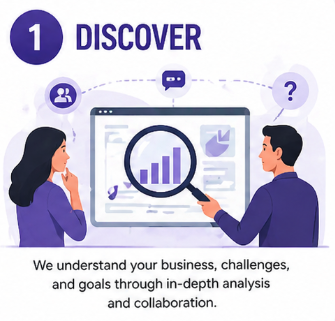
The discovery phase focuses on gathering detailed insights about user needs, business processes, and system requirements. It includes stakeholder discussions, requirement analysis, and current system evaluation. Teams identify gaps, define user journeys, and create clear functional and technical specifications. Prototyping and feasibility studies may also be conducted to validate ideas early. This phase ensures that all stakeholders share a common understanding of the solution, reducing ambiguity and minimizing risks. A thorough discovery process helps in building solutions that are both user-centric and aligned with business objectives.
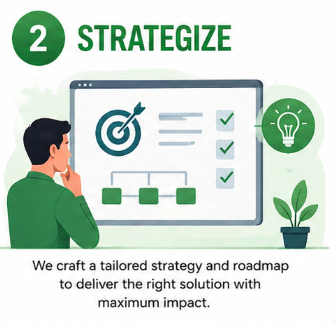
The strategize phase defines a clear roadmap aligned with business goals and market demands. It involves understanding client objectives, identifying key challenges, and outlining success metrics. Teams evaluate technology options, resource planning, and timelines to ensure a practical and scalable approach. This phase also includes risk assessment and prioritization to focus on high-impact outcomes. By creating a well-structured strategy, organizations set a strong foundation for execution, ensuring that every step in the delivery process contributes to measurable business value and long-term growth.
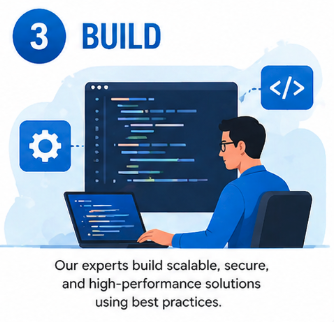
The build phase is where ideas are transformed into working solutions. Developers, designers, and engineers collaborate to create scalable, high-performance systems using modern technologies and best practices. This stage includes coding, integration, and continuous testing to ensure quality and reliability. Agile methodologies are often used to enable iterative development and quick feedback cycles. Emphasis is placed on clean architecture, security, and performance optimization. By focusing on efficiency and quality during development, teams ensure that the final product meets both technical standards and business expectations.
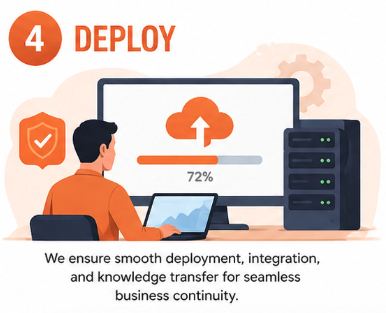
Deployment involves releasing the solution into a production environment in a controlled and efficient manner. Automated CI/CD pipelines are used to ensure smooth, consistent, and error-free releases. Infrastructure is managed using modern practices like containerization and Infrastructure as Code, enabling scalability and reliability. Deployment strategies such as blue-green or canary releases help minimize risks and downtime. Monitoring tools are integrated to track performance and system health. A well-executed deployment ensures that the solution is delivered quickly while maintaining stability and user satisfaction.
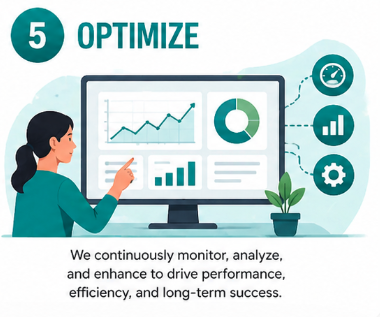
The optimize phase focuses on continuous improvement and long-term performance. It involves monitoring system behavior, analyzing user feedback, and identifying areas for enhancement. Teams work on performance tuning, cost optimization, and scalability improvements to ensure the system evolves with growing demands. Security updates, feature enhancements, and regular maintenance are also part of this phase. Data-driven insights help refine processes and improve user experience. Optimization ensures that the solution remains efficient, competitive, and aligned with changing business needs over time.
Integrations
Integrating Cutting-edge Web technologies
Integrating different systems, technologies, or tools is a crucial process enables seamless communication and functionality.


